

Job applications drain you in a particular way.
You’re not just filling out forms. You’re trying to sell yourself in writing to people you’ve never met, while showing why you’re a stronger choice than many others. And you do this over and over—sometimes dozens or hundreds of times—with little or no feedback when nothing happens. Now, we will know “How to Use ChatGPT for Job Applications (Without Sounding Robotic).”
You may know this feeling:
You spend forty minutes adjusting a resume.
You hit submit.
You feel a little hopeful.
Then… silence.
No reply.
No interview.
No notes.
Just nothing.
You start asking yourself:
Was it the resume?
The cover letter?
Your background?
Or did no one even open it?
After enough of those rounds, just starting another application can feel heavy.
It makes sense that people turn to AI for help. It also makes sense that it doesn’t always deliver the results they hoped for.
It is not that you get ChatGPT to write your CV for you — knowing how to use it in job applications. It’s about utilizing it to communicate what you know, more clearly, with intention and in less time. That difference matters. The version that gets filtered out the most is when you copy ChatGPT word-for-word and sent it in.
This guide walks you through what works, what to look out for and how to go ahead so that you can circumvent the mistakes people make which end up costing them callbacks they should have gotten.
Can ChatGPT Really Help with Job Applications?
Yes—but only in specific ways. Knowledge of the limits is equally important.
ChatGPT works well for:
- Making the way you describe your real experience clearer
- Matching your materials to a particular job posting
- Getting past the freeze of a blank cover letter
- Figuring out what a job description is really asking
- Finding wording that lines up better with what recruiter’s notice
It is not:
- A stand-in for having the right experience
- A guaranteed way to beat ATS filters if the keywords aren’t truly part of your background
- Something that understands your industry or a specific company unless you tell it
A common letdown: people improve their materials with ChatGPT, apply to 50 or 100 jobs, and still hear nothing. That happens. It usually isn’t because the AI made things worse. Experience gaps, tough markets, and how ATS systems work all play a role that better wording alone can’t always fix. ChatGPT helps you present yourself well. It cannot create experience you don’t have.
With that clear picture, here’s where it genuinely helps.

Before You Paste Your Resume: A Quick Privacy Note
When submitting your actual CV to ChatGPT, either remove or omit your home address, phone number and any other details that are not needed for the editing job.
ChatGPT does not require your phone number to get better bullet point phrases. Your name is fine—it’s professional. Your full address is not. Take half a minute to strip out what’s unnecessary. This small change that grows more valuable as AI tools become increasingly commonplace in everyday work.
10 Ways ChatGPT Can Actually Help Your Job Applications
1. Rewrite resume bullet points to show impact
This is among the most helpful things that ChatGPT do for job seekers. And lots of people write bullets that only describe their responsibilities: “Managed social media accounts.” ChatGPT excels at converting those into impact-focused bullets: “Oversaw three social media handles, increasing total engagement by 35% within six months.”
The limit: ChatGPT doesn’t know your real numbers. If you ask it to improve a bullet, it may suggest figures that aren’t accurate—like “generated $500K in revenue” when you actually generated $300K. Always stick to your true numbers. Its job is to frame what really happened, not invent achievements.
What to type:
“Here’s my resume bullet point: [paste it]. I’m applying for a [type of role]. Rewrite this to focus on results and impact rather than just duties. Use my actual experience—don’t invent numbers I haven’t given you.”
2. Tailor your resume to a specific job posting
However, the most common is sending the same resume to all jobs — and the easiest to solve with ChatGPT.
What to type:
“This is my resume: [paste your resume here]. What job title for keywords and phrases is missing from my resume? Which areas should I spend less time on, what is less relevant for this particular role?”
This shows the gap between what you have and what this role wants. It often surfaces keywords you wouldn’t have added on your own.
Tip: Paste the job description first, then your resume. That order helps ChatGPT focus on the target before working with your material.
If responses still feel generic, a separate guide on getting better ChatGPT answers can help.
3. Break through cover letter paralysis
The opening of a cover letter stops many people. You’ve stared at “Dear Hiring Manager” for twenty minutes and written nothing.
A common pattern:
Open a blank page.
Write one sentence.
Delete it.
Start over.
Focus more energy on the first paragraph than the rest of the letter.
And that is vitally where ChatGPT tends to come in most helpful.
The right way to do that is write a terrible first draft—messy, stream-of-consciousness rambling, whatever comes out of your fingertips and send it to ChatGPT. Prompting it to generate a cover letter from scratch almost always outputs vanilla prose filled with buzzwords like “synergy” and “leverage”. Giving it a real (even imperfect) draft and asking it to improve the language keeps more of your voice.
What to type:
“This is a loose draft of my cover letter—there highlighting system (and probably its length) might be messy but I want to preserve its ideas.] You are sharpened up, illuminated strongly, and more dynamic- but still a human being. No buzzwords, no synergy, leverage or passionate professional. [paste your rough draft]”
4. Explain transferable skills when you’re changing careers
The challenge that is wrought with specificity for career changers lies here: your experience has a real and applicable value, but the connection between what you have done and what you would do in this new role does not always make sense. ChatGPT can help you clarify that link, more often than not.
What to type:
“Change the word [your past field] to the job you were in and change [target field] —> to what type of job you want. My main responsibilities and achievements in my current position are the following: [list]. Tell me what skills look the closest to these but would come over well in this new field, and how I should portray those skills in front of a hiring manager who isn’t going to know my industry very well.”
5. Address an employment gap without sounding defensive
Gaps come up often—caregiving, health, study, layoff, or other reasons that feel awkward to put in writing.
What to type:
“My employment history contains a gap: [date] to [date]. What I was doing was [honest description like caregiving, health, studying.] Or help me tackle this in a cover letter that provides honest context—and keeps it short and minimizes its relevance to the letter. I want to admit it genuinely but without becoming defensive.”
6. Draft answers to standard application questions
Common job site questions that get asked again and again: “Why do you want to work here? Challenge Overcome — How is this different from Handling Pressure or Adversity? “What are your greatest strengths?” Writing fresh answers every time gets tiring.
What to type:
“My application — I am applying to [company type] as a [role] or they ask for: ‘Describe how you dealt with a challenging situation in the workplace. The reality of what happened was: [be honest about what actually happened.] Help me write a response that’s specific and genuine—not generic, and not AI-sounding.”
The key step: Describe your real situation first. Otherwise, you obtain the obscure reply of “I had a tough period and pulled together as a group” being given by 500 individuals.
7. Understand what a job description is actually asking for
Some postings use industry language that’s hard to parse, or they read like a long wish list.
What to type:
“My understanding of this position is not even close to 100%. Please summarise the core responsibilities in layman’s terms and outline the type of experience / skill sets that I suspect are truly being sought after by the hiring manager? [paste the job description]”
8. Find keywords for ATS compatibility
A resume is first passed through an Applicant Tracking System (ATS) which many companies use as a mean of solely filtering resumes before they reach a human being. Such systems search for particular words and phrases in the job posting.
What to type:
“Here’s a job description: [paste it]. What are the most important keywords and phrases that an ATS might scan for? Which of these should I make sure appear in my resume if I actually have that experience?”
Key Limit: Adding the keywords you do not actually have long-term no hope and even if an ATS doesn’t, a recruiter almost certainly will during the interview. Only use keywords that match real experience.
9. Get a second opinion on your application materials
Before you submit, ChatGPT can act as an early reviewer.
What to type:
“I’m about to submit this cover letter for a [role] position. Run it through and answer me: Is anything generic or AI in nature? Does that seem to differ from the job description? Is there anything missing that would make this stronger? [paste the letter and job description]”
10. Prepare for the interview by practicing answers
When ChatGPT finishes with the application, it can also help afterward.
What to type:
“I have an interview in a [role] for a [type of co.]. What are the 5 questions I am likely to face based on the job description? Offer me them one at a time and wait for my practice answer before making any comments.”
Asking for questions one at a time matters. It pushes you to think and answer instead of just reading a list.
Before and After: Resume Bullet Rewrite
Original:
“Responsible for customer service and helped with daily store operations.”
What to type:
“I’m applying for a retail management position. Here’s my current bullet: ‘Responsible for customer service and helped with daily store operations.’ Refactor this in a more result-oriented and enterprise style. Personal experience Me: 30+ customers a day, opening and closing the store. Don’t invent specific numbers I haven’t given you.”
After:
“Managed 30+ daily customer interactions while supporting full-cycle store operations including opening and closing procedures.”
Same experience. Clearer impression. And every word is something you can stand behind.
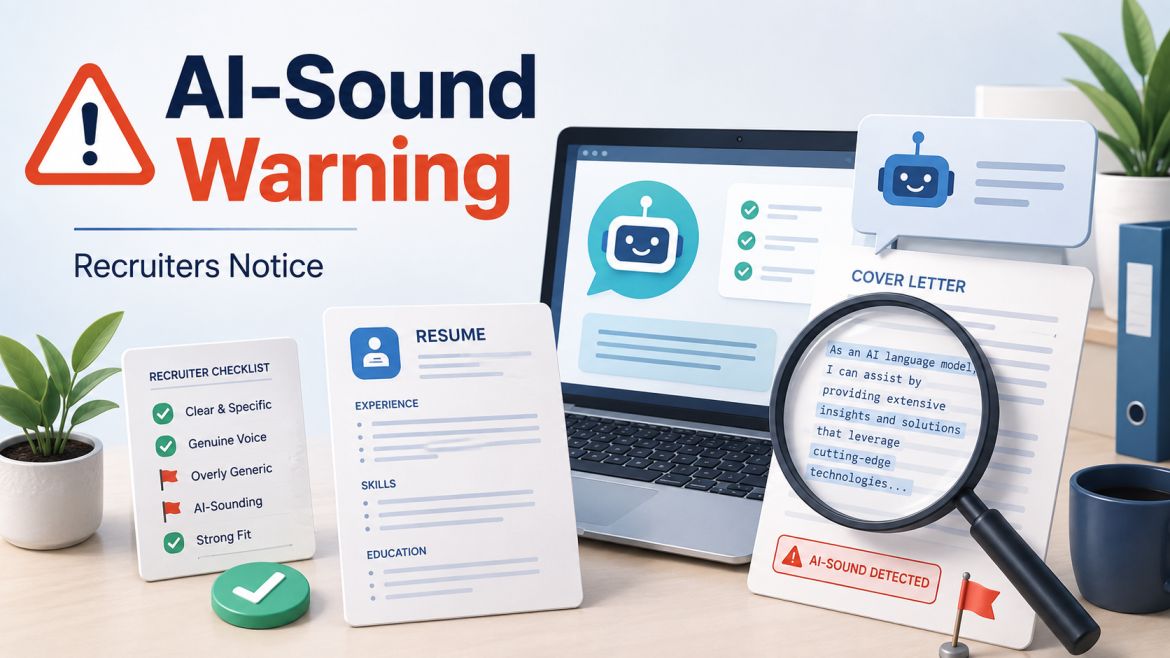
The AI-Sound Warning: What Recruiters Notice
Experienced recruiters often recognize AI-written language. They don’t need special tools. Certain phrases now show up so often that they stand out.
Watch for these in anything ChatGPT gives you:
- “Synergy,” “leverage,” “spearheaded,” “orchestrated”
- “Results-driven professional,” “team player,” “passionate about”
- Sentences that start with “I am a highly motivated…”
- Descriptions that sound stronger than you can comfortably explain in an interview
Read the output out loud before using it. If a phrase would feel odd to say in a real conversation, leave it out. The goal is language that matches who you are and that you can speak naturally—not the most impressive version of your resume that you then have to live up to.
Always Review Before You Submit
Treat this as a checklist.
Before submitting any ChatGPT-assisted application:
- Check every number and metric. ChatGPT sometimes adds plausible-looking statistics that aren’t yours. If you didn’t supply a figure, question any figure it added.
- Confirm the experience described is real. If a bullet mentions something you don’t clearly remember, verify it.
- We remove any buzzwords that don’t sound like us. And search for “synergy,” “leverage,” “passionate” and of course, “results driven.”
- Proofread for grammar. ChatGPT makes mistakes. It may regurgitate words, jumble up tenses, or produce stilted writing.
- Confirm company name and role Where template has been reused ensure all remnants of old name have gone.
- You are reading one way you would want someone to read it for. Is this the clearest and most honest way to express your experience? Would you be able to defend each assertion in an interview?
The aim is not a perfect document. It is an honest one that presents your real experience effectively.
What ChatGPT Is Good At (And Not Good At)
Good at:
- Improving the language of bullet points you’ve already written
- Spotting missing keywords when you compare your resume to a job posting
- Helping you describe experience you had but didn’t know how to phrase professionally
- Getting you past cover letter freeze with a starting draft
- Translating transferable skills across industries
Not good at:
- Knowing your specific industry culture or target company unless you tell it
- Predicting exactly what one ATS will filter for (there are many different systems)
- Filling experience gaps that don’t exist
- Knowing whether your salary expectations fit your market
- Replacing the judgment of a real recruiter or career counsellor
One extra note: If you’ve applied widely with ChatGPT-improved materials and still get no responses, the problem may not be the language at all. There are various external factors or influences on your application volume (especially when applying to highly competitive roles), how a company sets their ATS, experience thresholds based on the roles you decide to pursue and just the overall job market in your area that better writing alone cannot necessarily overcome. There is nothing an AI tool can give you that talking with someone in your industry—a mentor, a recruiter, a networking contact—does not.
Frequently Asked Questions
Is it ethical to use ChatGPT for job applications?
Yes. Letting AI assist you in expressing your wisdom more clearly is much like allowing a career coach to go over your resume or asking a friend to read through the cover letter you’ve drafted. The experience is still yours. The results are still real. All you are doing is presenting them better. It’s unethical to falsely claim experience or achievements that you have not obtained, with or without AI.
Can recruiters detect AI-written resumes?
Experienced recruiters are familiar with frequent AI vocal tics and phrasing. The best safeguard is to personalize the output; read it out loud, strip the buzzwords, add precise detail from your lived experience and ensure it sounds like you!
Should I use ChatGPT to write interview answers?
Use it to practice and rehearse not during reciting from the script. Answering based on your experience helps you to answer them in organic ways. The articulate AI answers that you recite that decrease at odds with how you think and talk usually seem scripted—and that can feel even worse than having a less polished but heartfelt answer.
What if I have gaps in my experience?
ChatGPT helps you our about what your do has. It can convey transferable skills, make a case for gaps — and connect the dots between your background and a role. It cannot generate experience that is non-existent, but it can bolster your case for the experience you do possess.
My applications keep getting no response. Is ChatGPT making things worse?
It’s rarely making things worse — but it may not be solving the real problem. If you’re sending out applications and hearing nothing back, the issue is often keyword matching (ATS systems), gaps between your experience and the specific roles you’re targeting, or just how crowded and competitive the market is right now. ChatGPT can improve the way you phrase things, yet talking with a recruiter or someone already working in your field will usually give you clearer insight into what’s actually going on.
One useful reminder:
The goal is not to sound impressive.
The goal is to sound qualified, clear, and real.
Those are not always the same thing.
Summary
ChatGPT is able to take the job-application method from a high-stress life event into something meaningfully much less stressful. On its own, it will not get you the job, but it can help clarify your true experience and align your materials to specific roles; parse through that blank-page paralysis that makes the job of job hunting so exhausting.
What works is to feed it your real experience, copy and paste the job description into the first bit of what you typed in, describe what you actually did instead of having it make up numbers (hopefully this will be ok), and that after each response examine everything carefully before submitting anything.
The approach that doesn’t: treating it like a resume machine that spits out ready-to-send documents with no real input or checking from you.
Used as a helper — not a replacement — it’s one of the more practical tools available for people dealing with one of the harder experiences in adult life.
Read More:
How to Use ChatGPT for Habit Building? (A Guide for Beginners)
Can ChatGPT Plan Your Trip? A Complete Guide to AI Travel Planning
Can you Use ChatGPT for decluttering your home? (Is this Really work)